
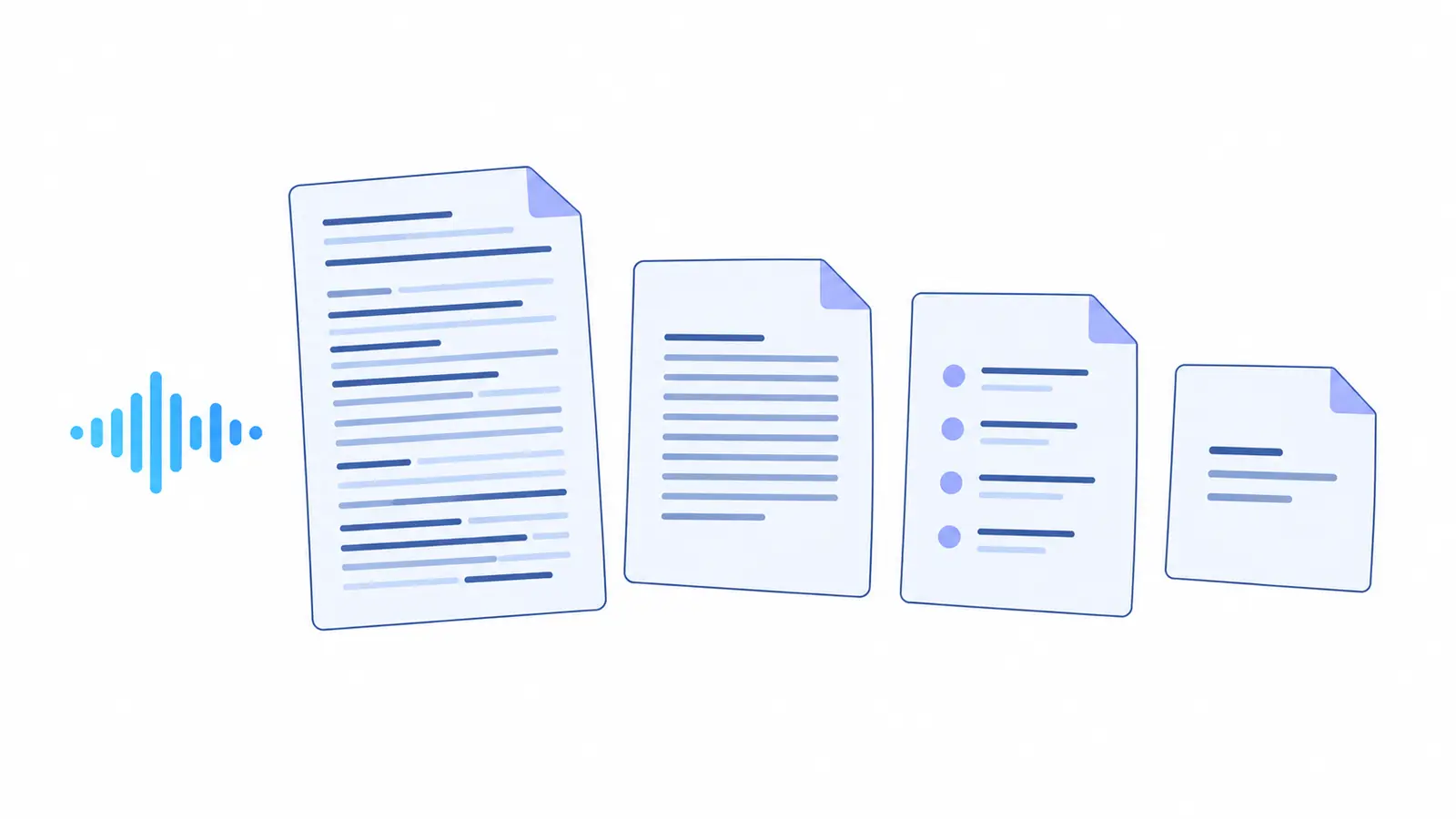
Full Transcript
This is the most detailed layer: the sequence of what's said, sometimes with timestamps. It's needed when formulations, quotes, and context are important. It takes longer to read, but there's less loss from shortening.
Summary and Overview
A summary retells the material in a coherent text: what was discussed, what topics were covered, and what conclusions were reached. It's convenient for a colleague who wasn't present but wants to understand the context.
The more condensed it is, the higher the risk of losing a condition or reservation. Important conclusions are verified with the full text.
Theses
Theses are a list of key statements. They're useful for notes, article outlines, webinar summaries, or preparing questions. A good thesis expresses one idea and doesn't pretend to be a direct quote.
Theses can combine several remarks, so for accurate attribution, you need to refer back to the original source.
Summary
A summary answers the question "what's the main takeaway from the recording". It's shorter than a review and focuses on the outcome. For a meeting, this could be a set of key decisions; for a lecture, the central idea and main conclusions.
A summary is especially handy at the start of working with lengthy material, but it's risky to use as the sole source of facts.
| Format | Volume | Purpose | What to Check |
|---|---|---|---|
| Transcript | Most detailed | Formulations, quotes, context | Words and facts from the recording |
| Brief Content | Coherent retelling | Understand the discussion flow | Conditions and reservations |
| Theses | Key ideas in a list | Notes and work plan | Meaning and authorship of ideas |
| Summary | Compact extract | Quickly see the main points | Conclusions and decisions |
One Fragment — Four Representations
Educational example, not a transcript of a real meeting.
- Transcript
- "Let's show the prototype on Thursday if we get the test results on Wednesday. Anna will check the results and confirm the date."
- Brief Content
- The team discussed showing the prototype. It was proposed to do it on Thursday, provided the test results are ready by Wednesday. Anna is to check the results and confirm the date.
- Theses
- Proposed to show on Thursday if the test is completed by Wednesday.
- Anna checks the results and confirms the date.
- Summary
- The show date is tentative: it depends on the test and Anna's confirmation.
The condition is preserved in all versions. The wording "The show will take place on Thursday" already changes the meaning: an assumption turns into a promise.
How to Choose the Right Format
If you need to quote something, open the transcript and the recording. If you need to understand the topic, start with an overview. If you need an action plan, review the key points and check the solutions. If you're short on time, read the summary, then delve into the important parts.
It's better to use formats in layers rather than sticking to just one.
- Need an exact phrasing
- Transcript + Source
- Need to understand the context
- Brief Overview
- Need to create a plan
- Key Points
- Need to see the main point
- Summary
Practical Checklist
- Determine if you need a fact, context, plan, or overall conclusion.
- Don't format a paraphrase as a direct quote.
- Verify decisions and numbers with the full text.
- Maintain a connection with timestamps.
- Use condensed formats for navigation.
How to Complete a Task in Transkribator
- Upload the recordingOpen Transkribator and add your ready audio or video. You can use a supported public link available for processing.
- Choose the depth of readingAfter processing, review the full text, timestamps, and available AI summary. The set of features depends on the plan.
- Check and saveVerify critical fragments with the recording and download the TXT. For the first test after registration, 10 minutes are available for free.
Key Points
- Different text layers answer different questions.
- The shorter the result, the more details are lost.
- Quotes require the full text and source.
- The optimal path is to go from a brief overview to the necessary fragments.
Frequently Asked Questions
Is a summary the same as a brief overview?
The boundaries can vary by service. Usually, a summary is shorter and more focused on the main outcome.
What should I read first?
For a long recording, start with an overview or summary, then open the full text in important parts.
Can a key point be quoted?
No, unless it is verified with the exact wording. A key point is a condensed thought, not necessarily verbatim words.
What format is best for a meeting?
Key points and summaries are convenient for an overview, but decisions, deadlines, and responsibilities should be verified with the transcript and recording.